


Can Foreigners Sign Costa Rica Closing Documents Remotely?
A signed offer is not the same thing as a completed property transfer. The question, “can a foreigner sign Costa Rica closing documents without traveling to Costa Rica?” usually arises after a buyer or seller has committed to a transaction but cannot be present for the deed signing. In many cases, the answer is yes. However, the correct method depends on the transaction, the authority being granted, the location of the person signing, and the documents that must be formalized and registered in Costa Rica.
The objective is not simply to arrange a remote signature. It is to ensure the closing documents accurately reflect the parties’ intent, that the person signing has valid authority, that payment and delivery terms are properly documented, and that the transfer can proceed through the Costa Rican National Registry when registration is required.
Can a foreigner sign Costa Rica closing documents remotely?
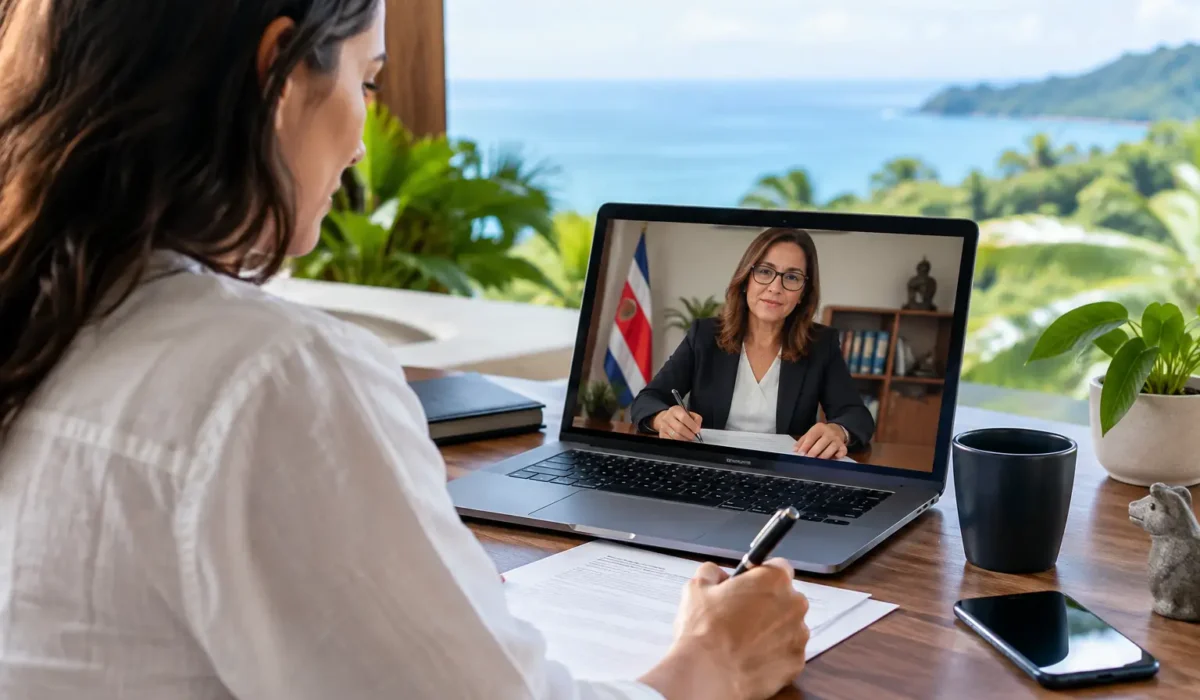
A foreign buyer or seller may often complete a Costa Rican real estate closing without personally traveling to Costa Rica by appointing a representative through a properly prepared power of attorney. That representative can then appear before a Costa Rican Notary Public and sign the closing deed within the authority granted.
This is materially different from a typical U.S. notary process. In Costa Rica, a Notary Public is an attorney with specialized legal authority and public responsibilities. For a real estate transfer, the Costa Rican notary prepares and authorizes the public deed, verifies the legal elements of the act, and submits the relevant instrument for registration. The notary is not merely witnessing a signature on a preprinted form.
Remote execution can therefore be practical, but it must be planned early. A power of attorney that is incomplete, too vague, improperly authenticated, or inconsistent with the proposed closing documents can delay the transaction or create unnecessary legal exposure.
The usual solution: a special power of attorney
For a specific purchase, sale, mortgage, or other defined transaction, a special power of attorney is often the more controlled approach. It authorizes a named representative to perform identified acts on behalf of the principal, such as signing a purchase deed, receiving or delivering specific documents, appearing before a Costa Rican Notary Public, or completing registry-related steps.
The scope should be matched to the transaction. A seller may need to authorize execution of the transfer deed and receipt of sale proceeds under clearly stated instructions. A buyer may need authority for the representative to sign the deed, accept title, complete tax-related closing formalities, or establish ownership through a Costa Rican corporation if that is the agreed structure.
Broad authority is not automatically better. A carefully limited power can reduce the risk that the representative has authority beyond what the client intended. On the other hand, a power that is drafted too narrowly may not allow the representative to address an ordinary closing adjustment, correction, or registration requirement. The appropriate balance depends on the file.
Executing the power outside Costa Rica
When the principal is outside Costa Rica, the power of attorney must generally be executed in a form that Costa Rican authorities can accept. The process may involve signing before a local notary or other authorized official in the country where the principal is located, followed by an apostille or legalization, as applicable to that country and document.
Apostille and legalization are not interchangeable. Their use depends on the issuing jurisdiction and the international authentication process available there. Documents prepared in a language other than Spanish may also require an appropriate Spanish translation for use in Costa Rica.
The original authenticated document is important. A scanned copy may allow the closing team to review the wording in advance, but it may not substitute for the original when the power must be incorporated, recorded, or relied upon in the notarial process. Clients should not wait until closing week to begin this coordination.
What should be reviewed before documents are signed
Remote closing should not reduce the level of due diligence. Whether the buyer is in San José, Canada, the United States, or elsewhere, the legal review should be completed before the representative signs on the client’s behalf.
For a real estate purchase or sale, this commonly includes verification of the registered owner, the property description, the cadastral plan where relevant, recorded liens or encumbrances, legal annotations, and the authority of any corporate seller or buyer. The closing deed should identify the property and parties consistently with the National Registry information.
The transaction documents should also state how the purchase price will be handled, when possession is delivered, which closing costs are being paid by each party, and whether any conditions must be satisfied before funds are released. If escrow coordination is part of the transaction, the parties should understand the written release conditions and the role of each professional involved.
A power of attorney does not cure an underlying title or documentation problem. It simply allows someone to act for an absent party. The same care is required for registry review, corporate authority, payment instructions, and deed preparation.
When personal travel may still be advisable
There is no universal rule that a foreign party must attend a Costa Rican closing in person. Still, travel can be sensible in certain circumstances. A client may prefer to attend when the transaction is high-value, the property has a complicated history, several sellers or heirs are involved, construction or possession issues remain open, or the client wants to inspect the property immediately before closing.
Personal attendance can also be useful when the buyer needs to open local accounts, meet service providers, inspect corporate books, or resolve practical matters that go beyond the deed itself. Those matters are separate from the legal ability to authorize a representative to sign.
The key point is that convenience should not dictate the legal structure. If a client cannot attend, the remote process should be designed around the actual requirements of the transaction rather than improvised through informal emails or unsigned instructions.
Corporate ownership adds another layer
Many Costa Rican properties are held by corporations. If a corporation is buying or selling, the closing team must confirm who has authority to bind the entity and whether that authority appears correctly in the corporate records and National Registry.
An individual who owns shares in a company is not necessarily the person authorized to sign a property transfer for that company. The company’s legal representative, recorded powers, corporate resolutions, and any required shareholder or board approvals must be reviewed. If the authorized corporate representative is abroad, a power of attorney or another properly documented corporate authorization may be needed.
This is one reason to obtain corporate documents early. A closing can be ready in every other respect but still pause because the signature authority was never properly established.
Avoid these common remote-closing mistakes
The most frequent problems are avoidable. Clients sometimes sign a power before the final transaction terms are known, rely on a generic form from another country, omit apostille or legalization requirements, or grant authority to the wrong person or entity. Others assume a digital signature or scanned notarization will automatically be accepted for a Costa Rican property transfer.
Another concern is payment fraud. A remote client should independently verify any request to change bank or escrow instructions. Do not rely solely on an emailed instruction that appears to come from a party to the transaction. Confirm changes through a known, independently verified contact method before funds are sent.
Finally, do not treat the registered transfer as an afterthought. The public deed is central to the transaction, but registration and the status of the filing matter for legal certainty. The closing plan should address what will be filed, who will follow the registration process, and how the client will receive confirmation of the completed work.
A practical path for an overseas buyer or seller
The process usually begins with a review of the proposed transaction and the client’s preferred signing method. The attorney and notary can then determine whether a special power of attorney is appropriate, prepare language suited to the transaction, and explain how it must be executed and authenticated abroad.
Before the closing, the client should receive a clear explanation of the proposed deed, the authority being granted, the property or corporate due diligence findings, and the payment and registration steps. A bilingual review is particularly valuable when the public deed will be prepared in Spanish but one or more parties are more comfortable reviewing the transaction in English.
CostaRicaNotary.com can assist clients outside Costa Rica with notarial coordination, powers of attorney, property and corporate document review, closing preparation, and National Registry matters. A careful review before any document is signed can preserve the convenience of a remote closing while protecting the client’s authority, property rights, and transaction funds.