What a Costa Rica Notary Public Actually Does
A signature on a purchase agreement does not transfer a Costa Rican property. A wire to an escrow account does not make a buyer the registered owner. In Costa Rica, the legal work that turns an agreement into an enforceable, registrable transaction is performed through a Costa Rica notary public – a professional whose role is far broader than the notary role many Americans and Canadians know.
That distinction matters whenever money, real estate, corporate ownership, or authority to act for another person is involved. The right notarial process helps establish legal certainty. An incomplete or improperly prepared instrument can create delays, registry defects, unexpected costs, or risks that are difficult to correct after closing.
A Costa Rica Notary Public Is an Attorney With Public Authority
In the United States and Canada, a notary commonly verifies identity, witnesses a signature, and administers an oath. Those functions are useful, but the notary generally does not draft the underlying legal agreement, advise on its consequences, or record the transaction in a public registry.
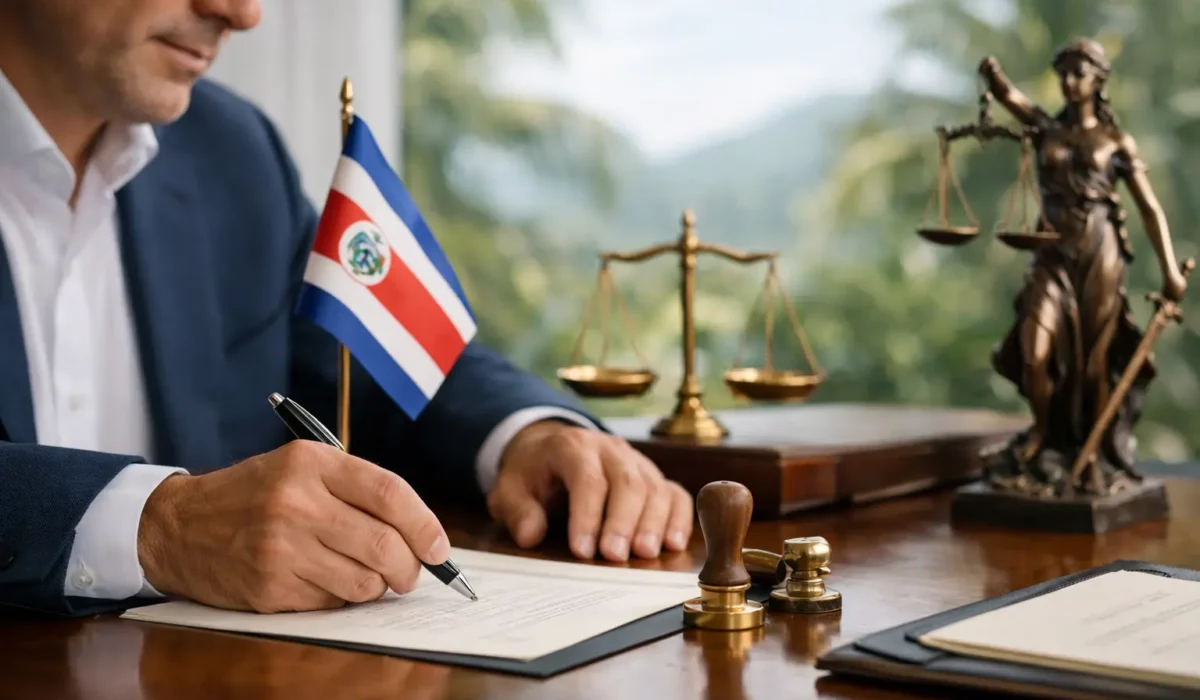
Costa Rica operates differently. A Costa Rican Notary Public is a licensed attorney who has received authorization to exercise notarial functions under Costa Rican law. The notary has public faith, meaning the public and government institutions may rely on the authenticity and legal form of the notarial instruments the notary prepares and authorizes.
A Costa Rican notary may prepare a public deed, known as an escritura pública, for transactions such as a property transfer, mortgage, corporate formation, share-related corporate actions, or a power of attorney. The notary may also issue certifications and authenticate documents within the scope of Costa Rican law. For many transactions, the notary is responsible for submitting the proper instrument for registration with the National Registry.
This authority does not mean every notary represents every party’s individual interests. A notary must act lawfully and impartially in the notarial function, while clients should still understand who is providing separate legal advice, who is reviewing the due diligence, and how potential conflicts are being handled.
Why the Notarial Role Matters in Real Estate Closings
A real estate closing is often the point at which foreign buyers first encounter the practical importance of the Costa Rican notarial system. The purchase may involve a direct transfer of a property, the sale of shares in a corporation that owns property, a mortgage discharge, a new mortgage registration, or several of these steps at once.
The public deed must accurately identify the parties, describe the property, state the legal transaction, and comply with applicable formal requirements. If the transaction is registrable, the instrument is presented to the National Registry. Registration is not a formality to postpone indefinitely. It is a central part of protecting the buyer’s rights against third parties.
Consider a buyer who signs a private purchase agreement after seeing an appealing home near the coast. Before funds are released and the deed is authorized, the legal team should confirm the registered owner, the property boundaries and plan information, recorded liens or annotations, restrictions, corporate authority where applicable, and the status of taxes or other obligations that may affect the closing. Depending on the property, the review may also need to address zoning, concession status, access, water availability, condominium rules, or municipal records.
A notarial deed cannot cure a problem that was never investigated. Proper due diligence should come before the final signing, not after the purchase price has been paid.
The National Registry Is Essential, But It Is Not the Entire Investigation
Registry review is one of the most important protections in a Costa Rican transaction. A certification and title history can reveal ownership, recorded mortgages, liens, annotations, and other relevant entries. However, a prudent review does not stop at a single registry search.
The condition of a transaction may depend on facts outside the property folio. A seller may be acting through a corporation. The corporation’s legal standing, current officers, powers, share structure, and corporate books may require review. A survey may conflict with physical occupation on the ground. A municipal matter may not appear in the same way as a registered lien. The appropriate scope depends on the asset and the transaction structure.
For that reason, experienced counsel coordinates registry research with corporate review, document verification, tax and municipal inquiries, and a practical review of the property’s legal history. The objective is not merely to prepare a deed. It is to identify material issues early enough for the client to make an informed decision.
Documents a Costa Rica Notary Public Commonly Prepares
Notarial work extends well beyond property purchases. The exact document and procedure depend on the legal purpose, the parties involved, and whether registration is required.
A public deed is commonly used for property transfers, mortgages, certain corporate acts, and powers of attorney. A broad power of attorney can grant significant authority to manage assets, sign documents, or undertake other legal acts. It should never be treated as routine paperwork. The scope, duration, revocation rights, and identity of the attorney-in-fact should be considered carefully before it is granted.
Notaries also support corporate matters, including entity formation, appointments, registered powers, amendments, and compliance filings. For an investor purchasing through a Costa Rican corporation, the transaction may require both corporate analysis and property analysis. A corporation can be a useful ownership vehicle in some circumstances, but it is not automatically the best choice for every buyer. Ongoing compliance obligations, ownership objectives, tax considerations, estate planning, and future sale plans all deserve attention.
Foreign documents create another common point of confusion. A document signed abroad may require an apostille or consular legalization before it can be accepted for use in Costa Rica. If it is not in Spanish, a formal translation may also be necessary. The correct path depends on the document, the country where it was issued, and the Costa Rican institution that will receive it.
Choosing the Right Professional for the Transaction
The title “notary” alone should not end the inquiry. Clients should confirm that the professional is a Costa Rican attorney and authorized Notary Public, understand the scope of representation, and ask who will perform the due diligence and registry filings. Clear answers are a sign of a properly organized transaction.
For a purchase or sale, it is also wise to establish the process in writing. The parties should understand the purchase terms, deposit conditions, escrow instructions, document requirements, expected taxes and closing costs, closing sequence, and registration steps. Trusted independent escrow coordination is particularly important because it separates the handling of funds from the legal work and establishes clear release conditions.
Clients should be cautious about pressure to sign documents they have not reviewed in a language they understand, release funds before agreed conditions are met, or rely solely on verbal assurances about title. These are not accusations against any particular participant. They are basic safeguards appropriate to a transaction involving substantial assets and a foreign legal system.
Representation and Conflicts Require a Clear Conversation
Costa Rican transactions often involve a notary selected by one party or used to prepare the deed for the closing. That arrangement can be lawful, but each client should understand the role being performed. A buyer may wish to retain independent legal counsel to review the purchase agreement, due diligence, escrow terms, and closing documents, particularly when the seller, developer, broker, or another participant has recommended the notary.
The practical question is straightforward: who is responsible for protecting your specific interests before you sign and before funds are released? The answer should be specific, documented, and consistent with the services being provided.
Registration Completes the Protection
After execution, a registrable instrument is submitted to the National Registry. Registry review may identify defects that require correction, such as an inconsistency in a document, a missing requirement, or an issue arising from an existing registry entry. Prompt follow-up matters because a transaction is not fully protected simply because the parties have signed a deed.
Once registration is completed, the client should receive confirmation and copies of the relevant registered documents or certifications. Corporate books, powers of attorney, tax records, and closing files should also be preserved in an organized manner. Good records are valuable later, whether the owner sells, refinances, applies for residency, completes estate planning, or needs to demonstrate the property’s legal history.
A Costa Rica notary public is therefore not a signature witness at the edge of a transaction. The notary is a legally authorized attorney whose work can shape the validity, enforceability, and registrability of the client’s most important documents. For a property purchase, corporate filing, power of attorney, or foreign document, the safest approach is to obtain bilingual legal guidance early, confirm the scope of work, and complete the necessary review before committing funds.
CostaRicaNotary.com can review the proposed transaction, explain the required documents and registry steps, and help clients move forward with the legal certainty appropriate to their investment.