


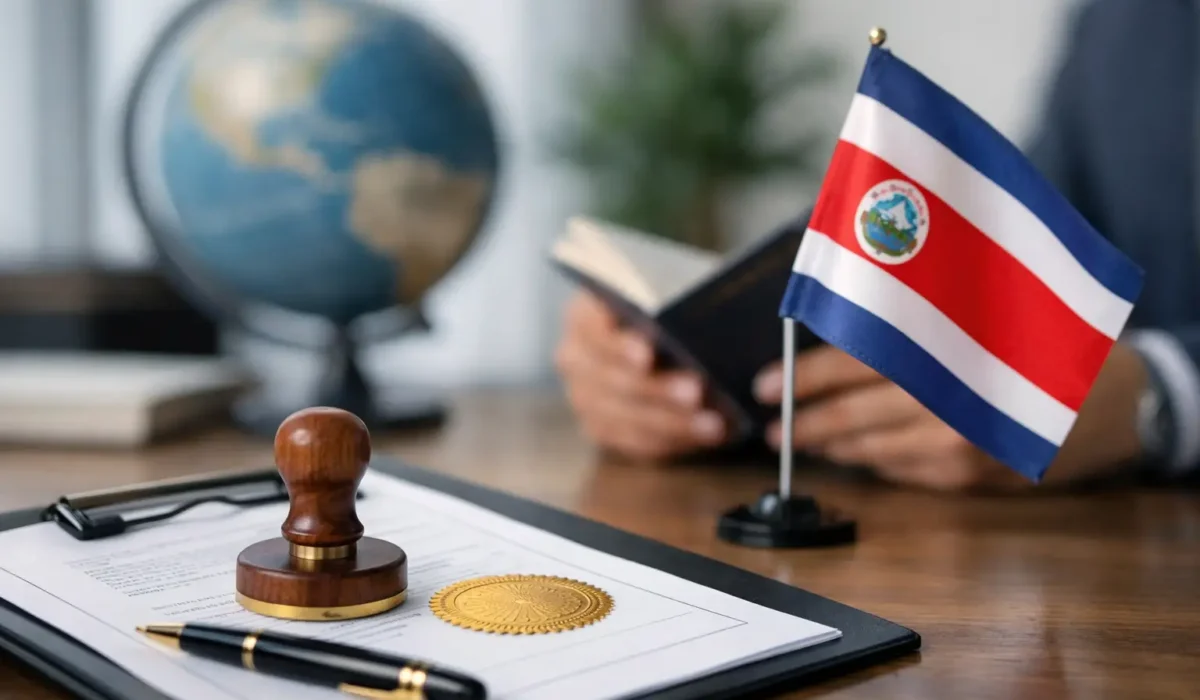
Apostille Documents for Costa Rica Explained
A property closing can be delayed by a document that appears perfectly valid at home but cannot be accepted in Costa Rica. A birth certificate, corporate resolution, power of attorney, or divorce decree may need an apostille before it can be used here. Understanding apostille documents for Costa Rica before you sign, travel, or transfer funds helps prevent last-minute legal and registry problems.
An apostille is not a general stamp of approval. It is an international certification that confirms the authenticity of the signature, seal, and capacity of the public official who signed a document. It allows public documents issued in one member country of the Hague Apostille Convention to be recognized in another member country, including Costa Rica.
What an Apostille Does – and Does Not Do
Costa Rica has applied the Hague Apostille Convention since 2011. When a foreign public document bears a properly issued apostille, it generally does not require consular legalization for use in Costa Rica. That can simplify cross-border transactions considerably.
However, an apostille does not confirm that a document is accurate, current, legally sufficient, or appropriate for its intended use. It only authenticates the official signature or seal on the underlying public document. A properly apostilled corporate certificate may still be too old for a bank, a power of attorney may still lack required authority, and a foreign court order may still require a certified Spanish translation before a Costa Rican authority can act on it.
This distinction matters most in real estate, corporate, estate, and immigration matters. Legal acceptance depends on both the apostille and the underlying document.
Which Apostille Documents Costa Rica Commonly Requires
The document requirement depends on the transaction and the receiving institution. A Costa Rican National Registry filing, a private bank compliance review, an immigration application, and a property closing can each have different requirements.
Documents frequently prepared for apostille use include:
- Powers of attorney authorizing a representative to buy, sell, mortgage, or manage property in Costa Rica.
- Corporate formation documents, certificates of good standing, board resolutions, and incumbency certificates.
- Vital records, such as birth, marriage, divorce, and death certificates.
- Background checks, court records, and police certificates used for immigration or compliance purposes.
- Academic records, professional credentials, and sworn statements required by a government agency or regulated institution.
For a property transaction, the most sensitive document is often the power of attorney. A buyer or seller may be unable to attend a Costa Rican closing and decide to sign a power abroad. The document may be apostilled correctly, yet still fail to authorize a Costa Rican Notary Public to complete the specific act required. For example, authority to “manage property” is not always sufficient authority to sell a particular property, grant a mortgage, or execute a deed with defined commercial terms.
The safer approach is to have the proposed power reviewed before execution. The authority, identity information, property description where applicable, corporate capacity, and signing formalities should match the intended Costa Rican transaction.
Where the Apostille Must Be Issued
Apostilles are issued in the country where the public document originated, not in Costa Rica. A U.S. birth certificate issued by a state authority normally requires an apostille from the competent authority in that state. A U.S. federal document follows a different federal process. The issuing jurisdiction matters.
Canada became a party to the Hague Apostille Convention in 2024, but the appropriate Canadian authority depends on the province, territory, and type of document. Documents from the United Kingdom, European Union countries, and other Convention members likewise must be apostilled by their designated competent authority.
A document signed before a local notary in the United States presents a common example. The notary’s signature is usually authenticated first at the state level, after which the state apostille authority issues the apostille. The exact sequence varies by jurisdiction. Obtaining an apostille from the wrong authority can result in a document that Costa Rican institutions cannot accept.
Before requesting an apostille, confirm whether the underlying document must be an original, a recently issued certified copy, a notarized signature, or a certified corporate record. An apostille cannot cure an improperly prepared source document.
Translation and Protocolization in Costa Rica
Spanish is the operative language for Costa Rican public records and most government procedures. A foreign document in English is not automatically ready for filing simply because it has an apostille. A certified official translation into Spanish may be required, particularly when the document will be submitted to a public authority, included in a notarial instrument, or used before the National Registry.
The translation requirement is not merely administrative. Legal terminology can change the meaning and scope of a document. A broad common-law power of attorney, for example, may use concepts that do not correspond neatly to Costa Rican civil and notarial practice. Careful translation and legal review protect against an unintended limitation or interpretation of authority.
Some foreign public documents must also be protocolized before a Costa Rican Notary Public can incorporate or use them in certain formal legal acts. Protocolization is the formal incorporation of a foreign document into a Costa Rican notarial protocol. Whether it is needed depends on the document and the transaction. It is often relevant when an apostilled foreign power of attorney will support a deed, corporate action, or Registry filing.
Costa Rican Notaries have a substantially different role from notaries in most common-law jurisdictions. They are attorneys specially authorized to prepare, authenticate, and register legal instruments affecting property, companies, mortgages, and other rights. Their review must therefore go beyond confirming that an apostille is attached.
Timing Matters More Than Most Clients Expect
Many apostille issues arise because clients treat the process as a final administrative step. It should be addressed at the beginning of the transaction instead.
Apostille processing times vary widely. Some authorities issue electronic apostilles quickly, while others require mailed originals or extended processing. Certified copies may need to be ordered before the apostille request can even begin. If translation, protocolization, bank compliance, or Registry filing is also required, a short delay can affect a planned closing date.
Document age matters as well. Immigration authorities, banks, escrow providers, and counterparties may require recent background certificates, corporate certificates, or civil records. The apostille does not extend the useful life of an outdated document. Requesting a document too early can be almost as problematic as requesting it too late.
Electronic apostilles can be valid, but they should be verified through the issuing authority’s official verification method. A scanned copy of an apostille is not necessarily the same as an electronically issued apostille. When originals are required for protocolization or a particular filing, relying solely on a PDF can create avoidable complications.
A Practical Review Before You Apostille
Before sending any document for apostille, identify its exact legal purpose in Costa Rica. The same individual may need a different document package to purchase property personally, acquire it through a corporation, apply for residency, or authorize a family member to act on their behalf.
A proper review should confirm the following four points: the document is the correct type and version; it is signed by the proper person or authority; the apostille will be issued in the correct jurisdiction; and any Spanish translation or protocolization requirement has been addressed. For companies, the review should also confirm that the signatory’s authority is supported by current corporate records.
This is particularly valuable where funds, title rights, or corporate control are involved. A replacement power of attorney or corrected board resolution may appear simple, but it can affect closing schedules, escrow release conditions, tax filings, and National Registry registration.
Documents Leaving Costa Rica for Use Abroad
The process also works in the other direction. Costa Rican documents intended for use in another Hague Convention country may require an apostille issued by Costa Rica’s competent authority. Depending on the document, preparation may include obtaining an appropriate Registry certification, executing a notarial instrument, or securing an official certified copy before the apostille can be requested.
A Costa Rican corporate certification or a notarized power of attorney may be legally valid here but still require apostille authentication for use by a foreign bank, court, title company, or government agency. The receiving country’s requirements should be confirmed before the document is signed or certified.
For documents from countries that are not parties to the Hague Apostille Convention, the older consular legalization process may apply instead. That process is different and often involves several layers of authentication. It should not be confused with an apostille.
When a document will affect a Costa Rican property purchase, company, inheritance matter, or immigration application, request a legal review before it is executed and apostilled. CostaRicaNotary.com can coordinate that review with the required notarial, translation, Registry, and transaction steps so the document supports the intended result rather than becoming an obstacle at closing. The most useful apostille is one attached to a document that was prepared correctly from the start.