


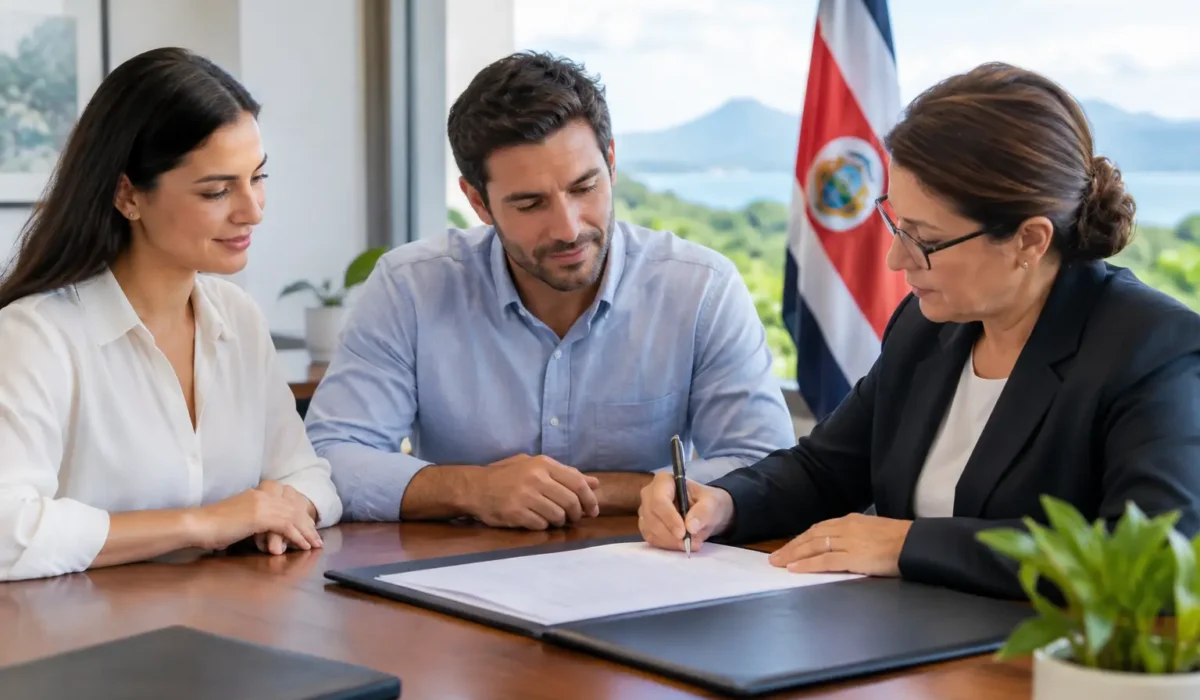
What Does a Costa Rican Notary Public Do at Closing?
A buyer may arrive at a Costa Rican real estate closing expecting a brief signature-witnessing appointment. Instead, the central document is commonly read, reviewed, signed before a Notary Public, entered into the notary’s protocol, and later presented for registration. That difference is why clients ask, “what does a costa rican notary public do at closing?” The answer is much broader than witnessing signatures.
In Costa Rica, a Notary Public is an attorney who holds specialized public authority. In a property transfer, the notary prepares and authorizes the public deed, verifies legal information relevant to the transaction, calculates and collects applicable closing charges for payment, and submits the transfer for registration. The notary’s role helps give the transaction legal form and evidentiary force, but careful planning before closing remains just as important as the signing itself.
What a Costa Rican Notary Public Does at Closing
The closing is the point at which the parties formalize the agreed transfer. Usually, this occurs through an escritura pública, or public deed. The deed identifies the parties, describes the property, states the purchase price and transfer terms, records relevant representations, and establishes how title is being conveyed.
A Costa Rican Notary Public prepares the deed in Spanish, the official language for registry purposes, and authorizes it after confirming the identity, capacity, and authority of those signing. If a party does not speak Spanish, the document and the signing process should be explained in a language the client understands. A client should never treat the deed as a formality or sign it without understanding its core terms.
The notary records the authorized instrument in the notarial protocol, which is the official book or record maintained under Costa Rican notarial practice. The authorized deed is then issued as a certified testimony for filing with the National Registry. This is a fundamental distinction from a typical U.S. notary, whose authority is generally limited to identity verification, acknowledgments, and witnessing signatures. A Costa Rican notary performs a legal and public function connected to the creation and registration of the instrument itself.
The Work Begins Before the Signing
A properly managed closing should not begin with a deed already waiting on the conference table. Before authorizing a transfer, the notary commonly reviews the registry status of the property and the parties’ authority to act. The depth of review depends on the matter, the instructions received, and whether separate buyer-side due diligence is being performed.
For a registered property, the review generally includes confirming the registered owner, the property identification number, and the legal description reflected in registry records. The review should also identify recorded mortgages, liens, annotations, easements, or other entries that may affect title. If the seller is a corporation, the person signing must have sufficient registered authority, or the company must validly grant that authority through the appropriate corporate action or power of attorney.
This work matters because a signed deed does not eliminate a preexisting registry issue. For example, if a recorded mortgage must be discharged as part of the sale, the closing documents and disbursement instructions should clearly address how that release will occur. If an annotation appears in the property record, the parties need to understand its nature and whether it can affect registration or use of the property.
Registry review is not the whole due diligence process. Depending on the property and transaction, a buyer may also need to investigate surveys, boundaries, municipal matters, land-use restrictions, condominium rules, water availability, access, occupancy, tax status, and the practical condition of improvements. A notarial closing is strongest when it follows a transaction review rather than substitutes for one.
Confirming authority and identity
At closing, the notary must be satisfied that the people signing are who they claim to be and have legal capacity to sign. Individuals commonly present valid identification. Corporate sellers or buyers require a review of the company’s registry information and the authority of its legal representative.
A power of attorney can permit a representative to sign, but it must be appropriate for the transaction and valid for use in Costa Rica. Foreign powers of attorney and supporting documents may require apostille or consular legalization and Spanish translation, depending on where and how they were issued. These details should be resolved well before closing, not while funds are waiting to be released.
Preparing the Deed to Match the Agreement
The public deed should reflect the actual deal, not merely a generic transfer form. The notary translates the commercial agreement into a legally operative instrument for Costa Rican purposes. This includes the parties’ names and capacity, the property description, the price and payment terms, the delivery of possession if applicable, and any conditions that remain relevant at closing.
The deed may also address matters such as an existing mortgage payoff, a reservation of rights, corporate ownership, or a special closing instruction. What belongs in the deed depends on the transaction. A simple cash purchase of a registered residential lot will not require the same drafting as a sale involving a corporation, financing, multiple owners, a right of way, or documents signed from abroad.
The notary should also ensure that the declared value and transaction information are handled consistently with the applicable legal and registry requirements. Parties should not assume that an artificially low declared value is a harmless shortcut. Inaccurate documentation can create tax, registration, evidentiary, and future resale concerns.
Coordinating Funds, Taxes, and Closing Documents
A notary may coordinate the closing with an escrow provider, the parties, lenders, real estate professionals, and other advisers. Escrow coordination is particularly useful when documents, releases, and funds must be exchanged in a defined sequence. The appropriate sequence should be established in writing, with clarity about what must occur before funds are released.
Costa Rican property transfers commonly involve transfer taxes, documentary stamps, registry fees, and notarial fees. The allocation between buyer and seller is a matter that should be addressed in the parties’ agreement. The notary calculates the applicable closing charges based on the transaction and prepares for their payment as part of the filing process.
It is sensible to request a clear closing statement that identifies the purchase price, deposits or credits, professional fees, taxes, stamps, registry charges, escrow charges where applicable, and any payoff or withholding items. This is not simply an accounting exercise. It allows the parties to verify that their instructions are being followed before signatures and disbursements occur.
Filing With the National Registry
Signing the deed is a major milestone, but it is not the final protection a buyer expects. After authorization, the notary submits the certified testimony for registration with the National Registry. The Registry examines the filing and may register it, issue an objection, or require correction if it identifies a problem.
Until the transfer is registered, the registry record may still show the prior owner. The timing and risk analysis can vary depending on the facts, including the status of the property, pending annotations, financing, the agreed payment structure, and the order in which documents are presented. This is why parties should discuss filing strategy and the intended funds-release sequence before closing.
If the Registry raises an issue, the notary evaluates whether a clarification, correction, additional document, or other response is appropriate. Not every issue has the same significance. Some are technical drafting or filing matters, while others may reveal a more substantial title, authority, or documentary problem. No responsible professional should promise registration before reviewing the specific transaction and the Registry’s response.
What the buyer should receive
After closing, clients should retain a complete closing file. It should normally include the executed deed testimony or later registered record, a closing statement, relevant registry certifications or searches, proof of payments made in connection with closing, and copies of any powers, corporate documents, releases, or escrow instructions used in the transaction.
If title is being acquired through a Costa Rican corporation, the client should also understand the company records, share ownership documentation, legal representation, and any continuing filing obligations. Owning property through a company does not remove the need for organized corporate records or proper authority for future decisions.
The Notary Is Essential, but Independent Advice Still Matters
The notary’s public role requires legal rigor and impartiality in authorizing the instrument. At the same time, buyers and sellers should be clear about who is providing them with separate legal advice and whose interests are being represented in negotiations. In a straightforward transaction, the same notary may be able to prepare the closing instrument for the parties. In a transaction with competing concerns or unusual risk, separate counsel may be appropriate.
For example, a buyer concerned about a boundary discrepancy, an unregistered construction, a seller-financing arrangement, or a complicated corporate structure may need advice focused specifically on that buyer’s exposure. The public deed can formalize the transaction, but it cannot repair a commercial decision that was never adequately investigated.
A well-managed Costa Rican closing is not defined by how quickly signatures are obtained. It is defined by accurate documents, verified authority, deliberate handling of funds, and a filing strategy that supports proper registration. If you are buying, selling, or transferring property in Costa Rica, CostaRicaNotary.com can help review the documents and coordinate the notarial and registry steps before you commit to closing.